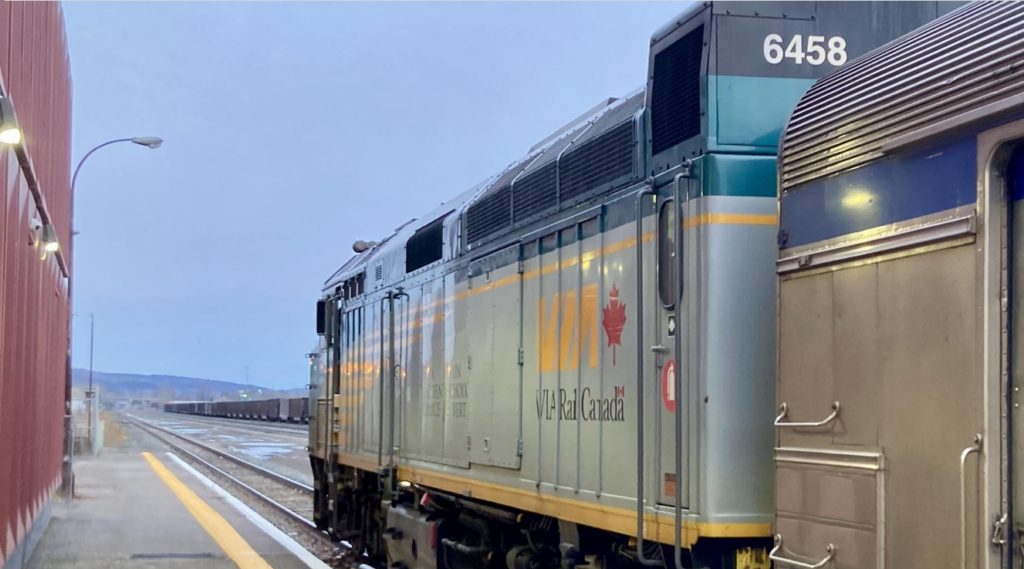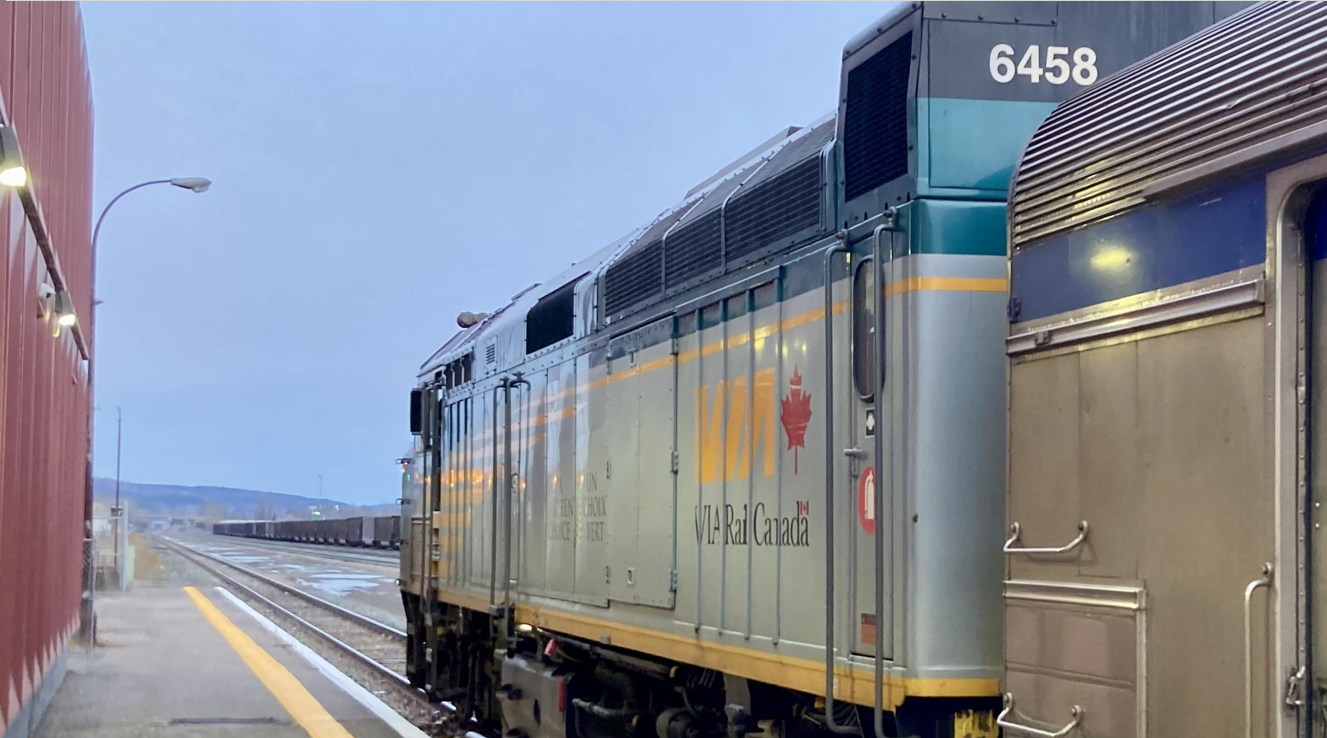
There’s a train that runs straight through Prince George, but it feels like not that many people actually use it… what gives? This reading break I decided to take the train from Prince George to visit my family in Terrace, and figure out why this mode of travel is so underutilized.
As a member of the SGU, I try to lower my personal greenhouse gas emissions as much as I can, and trains generally emit far less carbon per kilometer than airplanes or personal vehicles. Taking emission rates from that article, I found that traveling the approximate 575 km to Terrace (according to google maps) results in the emission of 23.6 kg, 76.5 kg, and 98.3 kg of carbon dioxide for trains, airplanes and single occupancy cars respectively. From an environmental point of view, trains seem like a no-brainer; and multiplied over the large number of potential train riders, it’s a lot of potential emissions reductions.
Prince George is serviced by VIA Rail’s Skeena line, travelling between Jasper, AB and Prince Rupert, BC. The train initially leaves Jasper and meanders through the Rockies and then into the Interior Plateau, before heading into the Lakes District and following the Bulkley and Skeena rivers through the Coastal Mountains to Prince Rupert and the Pacific Ocean, passing through Vanderhoof, Houston, Smithers, and Terrace along the way. The cost of a ticket can vary wildly depending on where you get on and off, as well as when you book. For my ticket for Prince George to Terrace I spent $80 each way, but a ticket from Jasper to Prince Rupert might cost more like $160. If you do your research (and check for discounts!) it’s very possible to save money by taking the train instead of flying.
Right about now, this might sound too good to be true. And yeah, there are a couple reasons for the lack of ridership that became especially apparent to me as I embarked on my trip:
First, the train runs only 3 times a week, leaving PG at 8:00 am and arriving in Terrace at 6:00 pm. There is no bus service from UNBC to downtown that arrives before 8:00 am on a Saturday, so getting someone to drive you there is necessary. This could easily be fixed by having line 15 leave the bus loop half an hour early, or adding an additional trip earlier in the morning.
Second, the state of the food available on board is really sad. I’m used to a student’s diet of whatever the cafeteria summons from the pits of hell and a lot of coffee, so I don’t think I’m a gourmet; but there really wasn’t much in the way of good food on board. It was pretty much airplane food, but without the free drink and cookie. For sale, there was coffee, pringles, sandwiches (which had a high sodium content warning on the plastic packaging) and beer, if that’s how you prefer to start your day. In other words, I highly recommend bringing snacks for the trip as it will make the whole thing a lot more enjoyable. While I don’t think that this lack of good food is a large deterrent to ridership, it’s definitely not making the choice any more appealing, especially considering how long the ride is.
Third, the trains seem to have trouble staying on schedule, but I don’t think this is entirely VIA Rail’s fault. According to the attendant, the passenger trains are required to yield to cargo service. This means that the train is often significantly off schedule, especially towards the end of the route (by the time I got to Terrace, we were 45 minutes late). I was lucky to have a ride, but if I was relying on a bus I would definitely be worrying about making my transfer. The problem seems to be quite an issue, because in their 2025 Q1 report, they reported an “on-time performance” rate of only 30%, declining from 72% in 2024. This incredibly poor performance erodes public trust, and makes it even more likely for potential riders to find alternatives.
The train ride, despite everything else, was well worth the trouble. The scenery along the rails was way better than what you would see along the highway, and there’s plenty of wildlife. Also, the larger seats and not needing to drive means you can catch up on a lot of sleep on the way, or do some actual reading during reading break (yuck).
Overall, VIA Rail has a lot of potential, and if it can improve it has the potential to become a great method of getting around Northern BC, and Canada in general. There definitely has to be more communication between the train and local public transportation, more funding, and better infrastructure to allow for more timely service. Having done it myself I can definitely see why people might be initially hesitant to take the train, but I implore those interested to give it a chance. The scenery is beautiful, the carbon savings are awesome, and with a few improvements I am certain more people will choose the train over driving or flying.