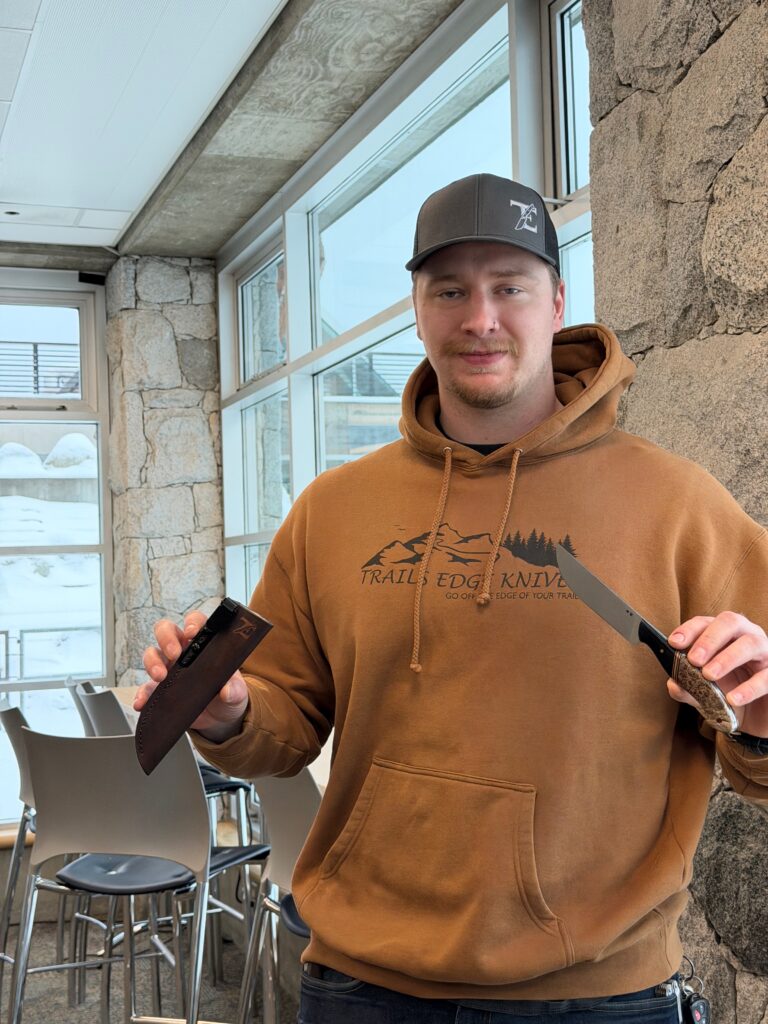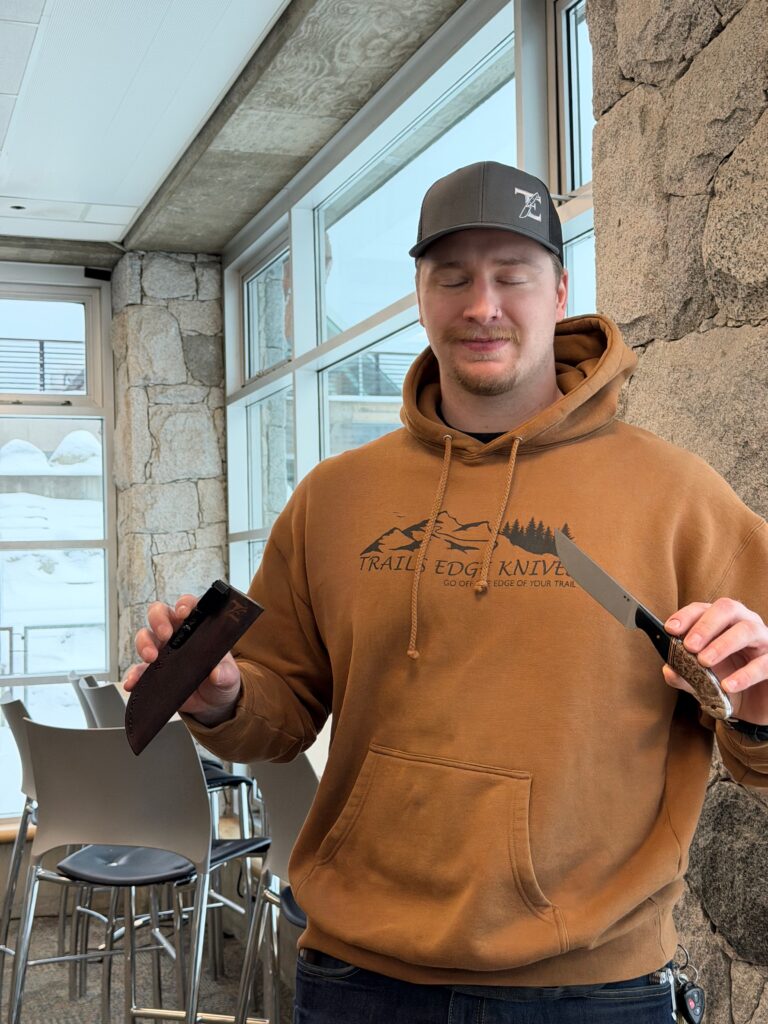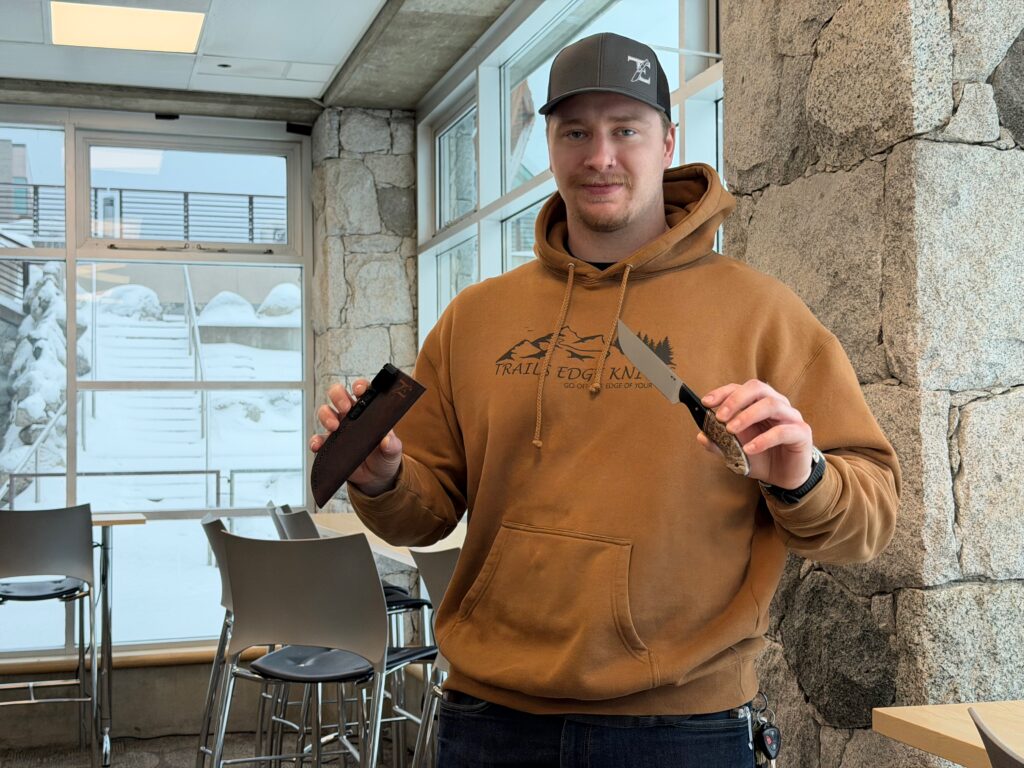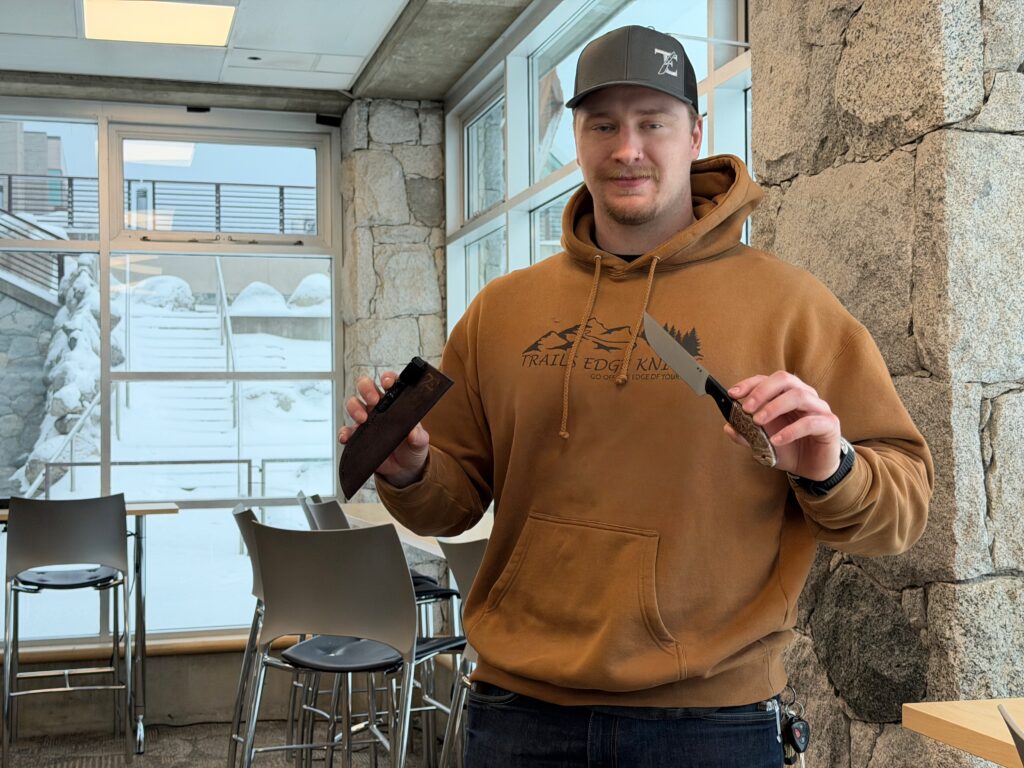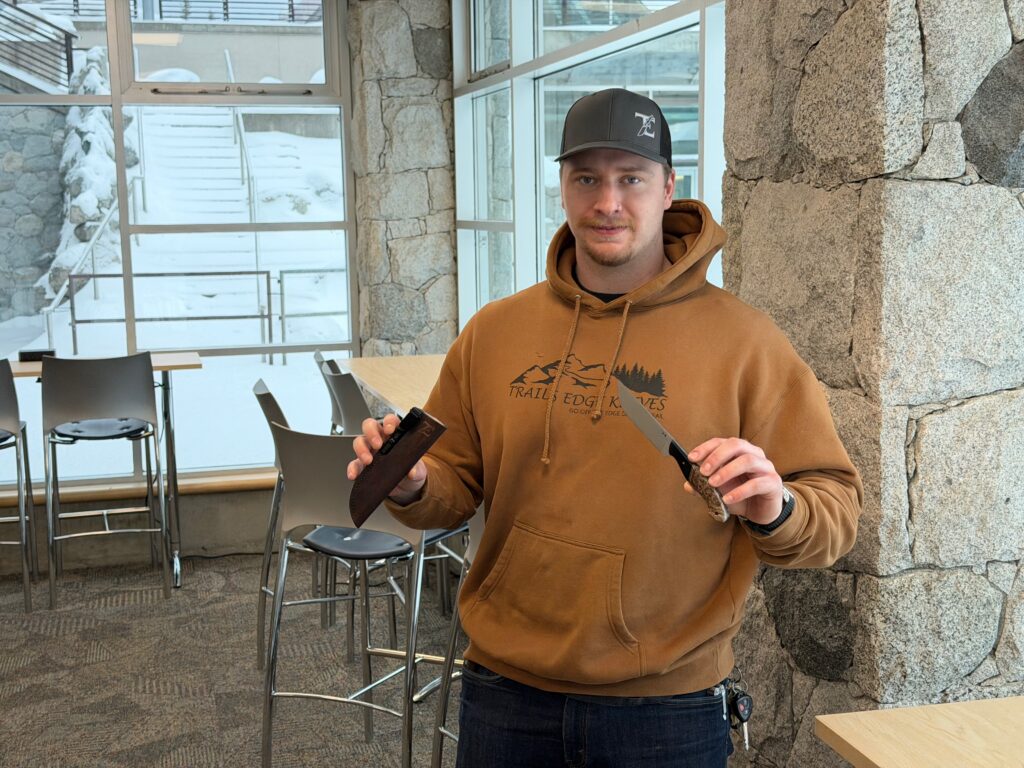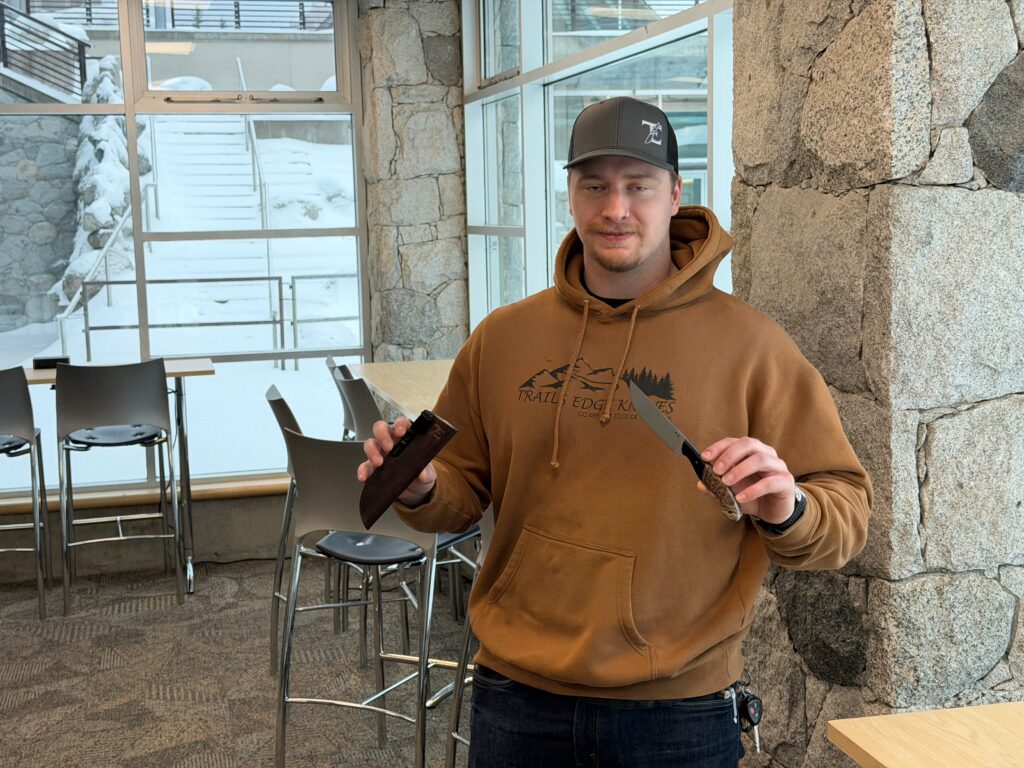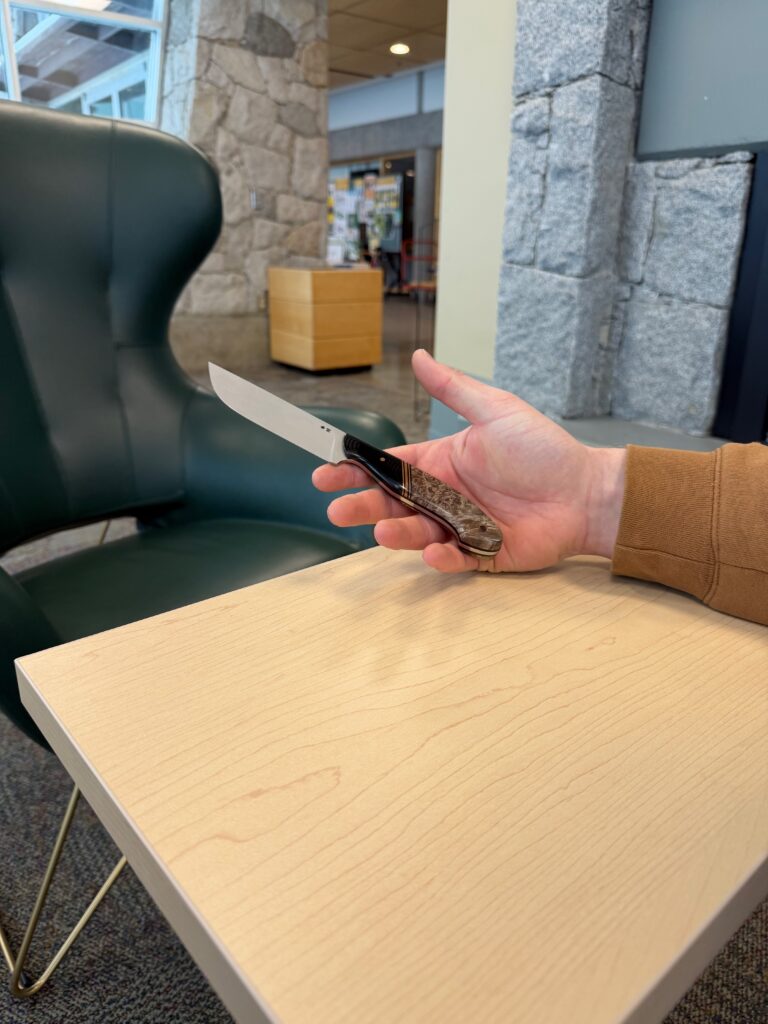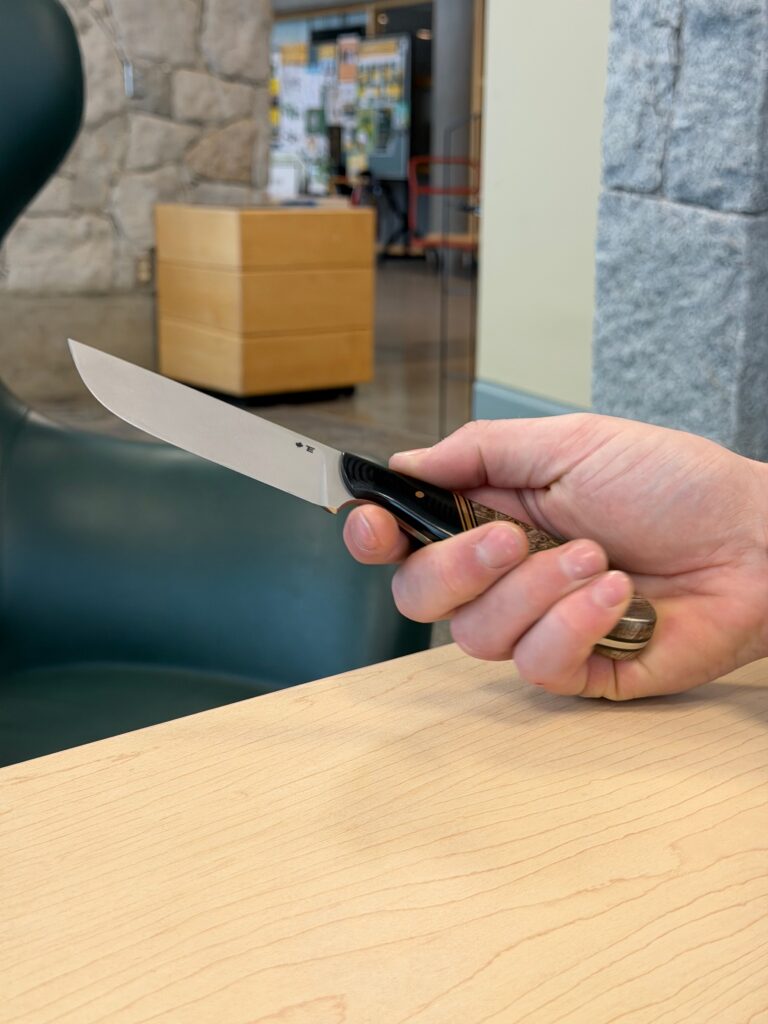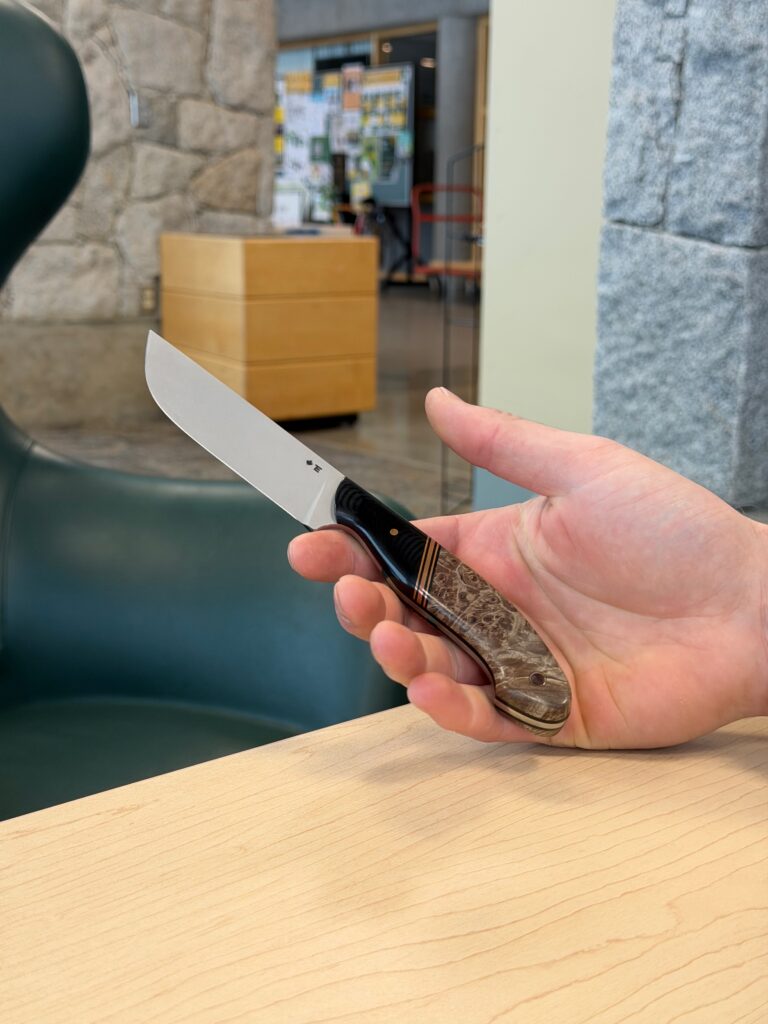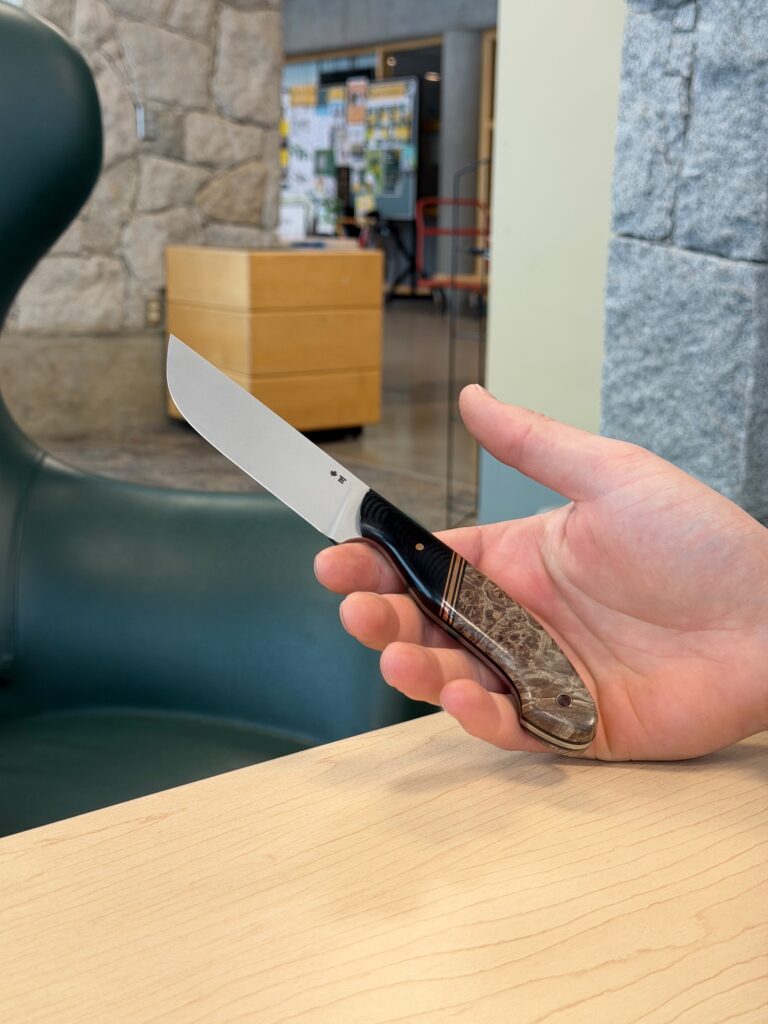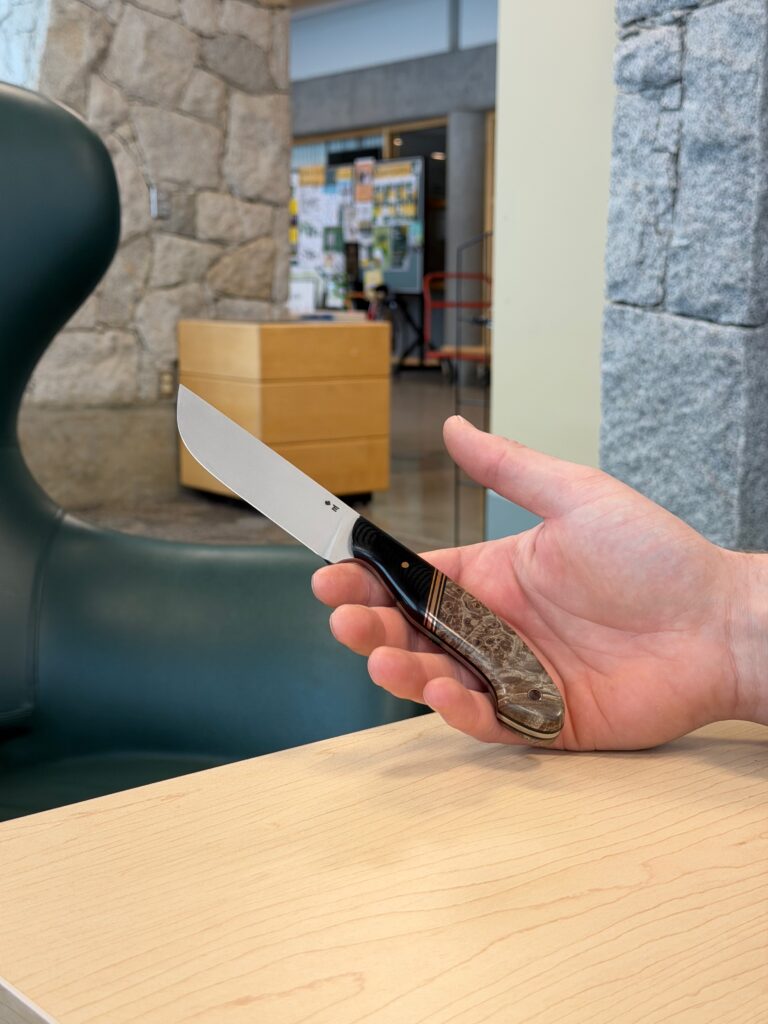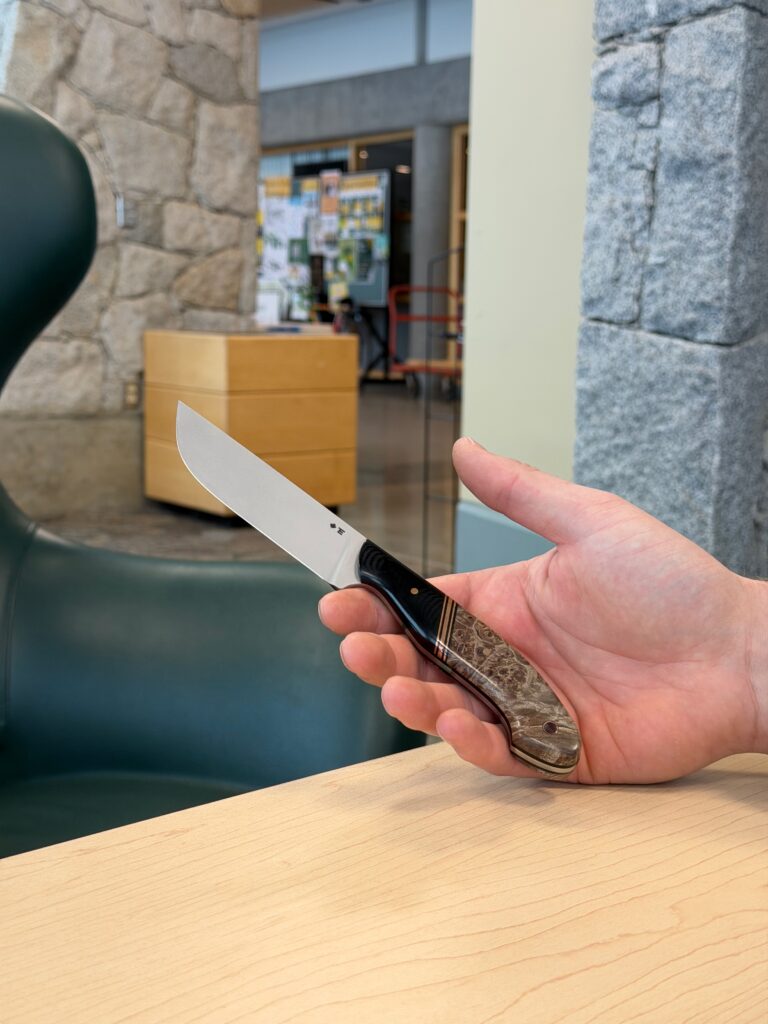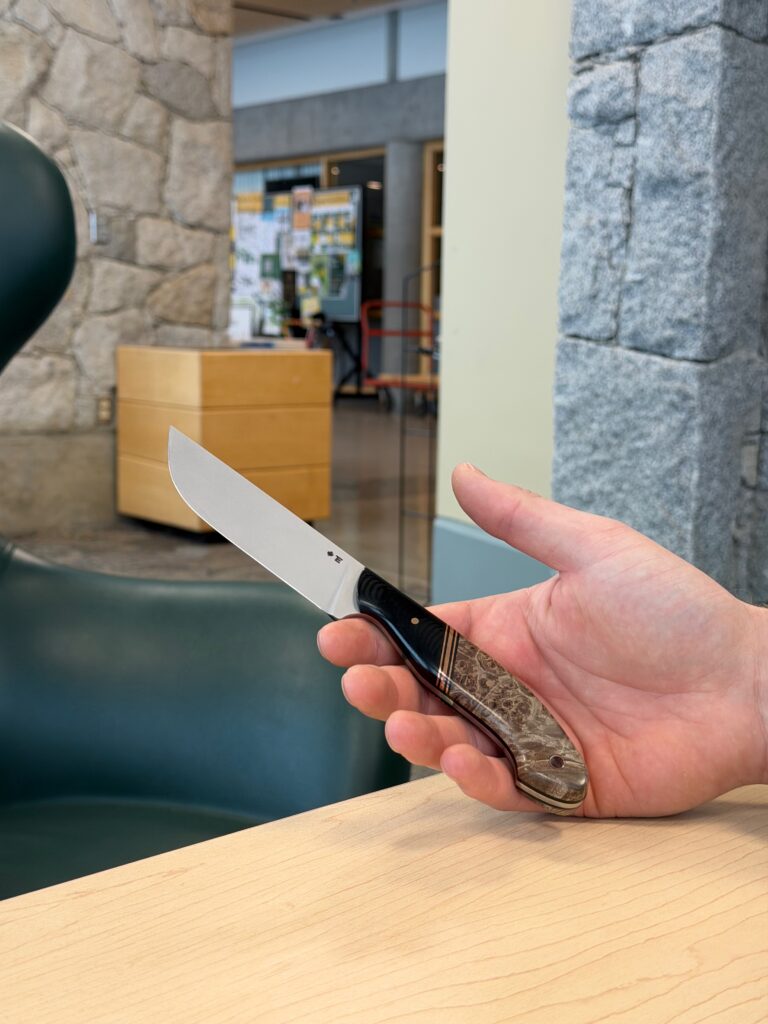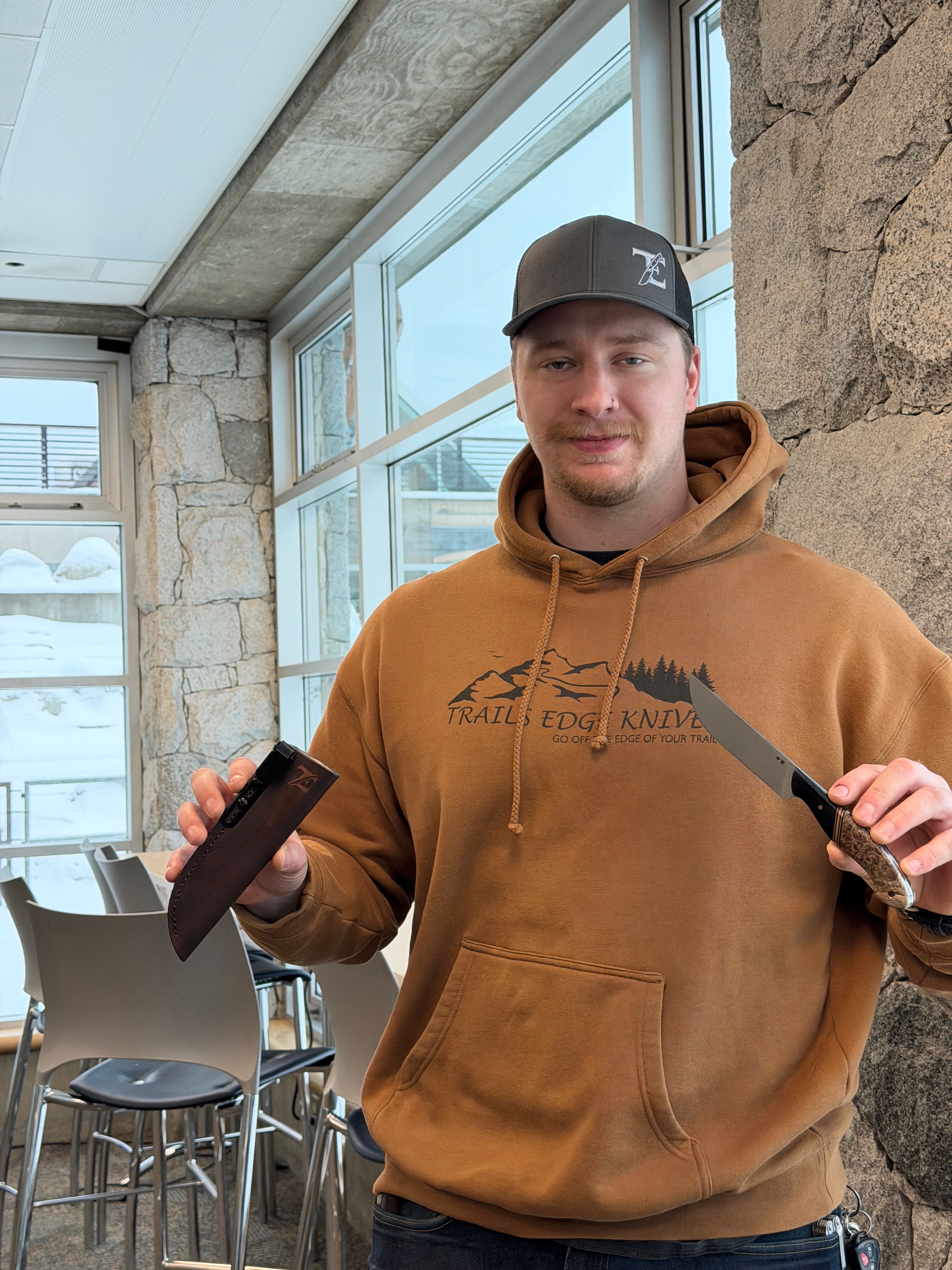
When Dylan Broeke graduated from the University of Northern British Columbia with a Bachelor of Science in Geography, he already had a side hustle that was shipping handmade knives across the world. What started with $150 worth of basic tools and a Christmas break experiment in 2020 has grown into Trails Edge Knives, a custom knife-making business rooted in Northern BC and built entirely by hand.
## __Small-Town Roots, Small-Campus Feel__
Dylan grew up in Gibson’s, a small town on the Sunshine Coast near Vancouver with a population of roughly 2,500 to 3,000 people. When the time came to choose a university, the idea of attending a large, overcrowded institution didn’t appeal to him. He visited UNBC for a Student for a Day event during Grade 12 and immediately connected with the tight-knit community atmosphere that reminded him of home.
“Instantly I fell in love with the community feeling and how everybody knew each other,” Dylan recalled. “It felt like the small community that I grew up in.”
His academic path was anything but linear. He started in a joint math-physics program, shifted to math and then math-business, before finally landing in geography. Growing up mountain biking and exploring the outdoors on the Sunshine Coast had already laid the foundation. “Being able to learn and study the outdoors and environmental science was fascinating for me,” he said. “All my electives were already in outdoor science, so I switched into geography.”
Today, Dylan works in UNBC’s meteorological department as a hydrometeorologist, building and maintaining weather stations and water temperature loggers across Northern BC.
## __A Maker’s Instinct__
Dylan’s entrepreneurial spirit traces back to Grade 10, when a serious mountain biking accident redirected his energy toward the woodshop. He started turning wooden pens on a lathe and sold a couple hundred to friends, family, and neighbours. From there, he moved into handmade rings, first from wood and plastic, eventually from stainless steel, titanium, and even pieces of Muonionalusta meteorite. That jewellery work continues today through his companion business, Stainless Edge Studios.
“That first piece that you make that’s successful is a feeling of satisfaction that’s just unbeatable,” he said.
But knives had always been in the background. Dylan remembers his first knife fondly, a bright orange “paramedic” folding knife, half-serrated, complete with a glass breaker and seatbelt cutter. That early fascination grew through years of carrying pocket knives and folding knives in the outdoors, and eventually the question became inevitable: could he make his own?
The answer came during Christmas break of 2020, in his first couple of years at UNBC. Armed with about $150 in rudimentary tools, a 1×30 belt grinder, a small paint can forge, and hand files, Dylan made his very first knife. He used a mystery damascus billet from Amazon, padauk wood scales, cut-off nails for pins, and super glue to hold it all together. He’s the first to admit it wasn’t pretty.
“It’s a hot piece of garbage,” he laughed, “but I still have it to this day because it’s a reflection of where I’ve come from.”
Being a full-time student made progress slow. With access to his shop only about four months a year during breaks, Dylan had to squeeze his craft into summers and holidays. But when he graduated in mid-2023, everything changed. He moved his shop, gained year-round access to his tools, and let his creativity run free.
## __From CoastalEDC to Trails Edge Knives__
The business itself has evolved alongside Dylan’s skills. He originally launched in 2022 under the name CoastalEDC, but as his focus narrowed to knives and his style shifted toward bushcraft, hunting, and camping blades, the name no longer fit. Trails Edge Knives was born in 2023, tying neatly into his jewellery brand, Stainless Edge Studios.
His workshop has come a long way from those early days too. The 1×30 grinder and paint can forge have been replaced by a proper 2×72 belt grinder, a heat treating oven, and professional equipment, though Dylan is quick to point out that anyone can get started with far less.
## __The Craft Behind the Blade__
For anyone curious about getting into knife-making, Dylan is quick to lower the barrier to entry. A hand file, sandpaper, a hand drill, and some nice wood for the handle can produce a beautiful knife for well under $100. More expensive tools reduce the time per knife dramatically, but the entry point is accessible.
One area Dylan has invested serious time in is blade geometry. He has recently started convexing the bevels on his knives, a technique where the edge profile curves slightly outward rather than forming a straight V-shape. The result is noticeably less friction and a much smoother cut. It’s a subtle detail that’s hard to spot visually but immediately noticeable in use.
Durability is another obsession. Having learned from his ring-making days, where thin wooden rings were prone to cracking and breaking, Dylan shifted toward materials like titanium and stainless steel that last. The same philosophy carries over to his knives. He tests his blade finishes rigorously, wanting them to hold up not just on day one but after months and years of use.
## __Tested in the Field__
Dylan’s day job gives him the perfect testing ground. Out building and servicing weather stations in remote areas of Northern BC, he regularly puts his knives to work clearing vegetation, cutting zip ties, stripping wire, and opening boxes.
He once used his knife to pound through an eighth-inch braided steel tether to retrieve a lost stream temperature logger in the backcountry, after driving 120 kilometres down a forest service road, boating 45 minutes up the Nechako Reservoir, and bushwhacking two kilometres through the bush.
“Sure, it dulled my blade a little bit,” he said, “but I spent five minutes on my sharpener and it was back to shaving sharp.”
## __Not One Knife to Rule Them All__
Dylan is passionate about educating people on the variety within the knife world. He breaks it down into several broad categories: everyday carry (EDC) pocket knives for daily tasks, bushcraft knives built for outdoor survival, hunting knives designed for skinning and butchering, and chef knives ranging from large German-style blades to slim and a bit more delicate Japanese-style santoku and paring knives. Each type demands different geometry, profiles, and materials.
“There’s not one knife or one tool to do everything,” he said. “Everything has its own duty.”
Right now, his most popular orders are a split between EDC pocket knives and hunting knives, with many local hunters seeking clean, smooth-cutting blades with carefully considered geometry.
## __Custom Commissions and What’s Next__
What sets Trails Edge Knives apart is the one-on-one custom commission process. Dylan works directly with each customer to design a piece tailored to their hand size, grip preference, blade profile, materials, colours, and intended use. He doesn’t charge extra for customization, only for materials and time. The collaborative process has led to some of his most creative work, producing combinations he wouldn’t have thought of on his own.
“Every piece is very unique. There’s no two pieces perfectly alike,” Dylan said. “If people are looking to create a one-of-a-kind piece of functional art, we can totally work together to design something very unique to you.”
He also hand-cuts and stitches custom leather sheaths for every knife besides culinary pieces, designed to either clip into your pocket or hang on your belt.
Every knife is completely handmade in Northern BC, and Dylan spends his evenings and weekends in the shop after returning from fieldwork. For inquiries or custom orders, visit trailsedgeknives.com, reach out via direct message on Instagram @trailsedgeknives, where he regularly posts photos, videos, and updates on his latest builds, or by email at trailsedgeknives@gmail.com.