You’ve probably used one of UNBC’s water bottle refill stations. Maybe you’ve filled up before class in the Teaching and Learning building, or grabbed a drink between study sessions in the library. Maybe you’ve noticed some stations look cleaner than others, or wondered about that slightly different taste from the fountain on the fourth floor.
**We decided to find out what’s actually in that water.**
Over the course of November, we collected water samples from 11 refill stations across six campus buildings and sent them to UNBC’s own Northern Analytical Laboratory Services (NALS) for professional metals analysis. The lab tested for 25 different metals, including potentially harmful ones like lead, arsenic, and cadmium.
The bottom line? The water is safe. But the details tell an interesting story about campus infrastructure, and about a Northern BC success story happening right under our noses.
## The Results: Safe, But Not Identical
Let’s start with the good news: none of the 11 water samples exceeded Health Canada’s Maximum Allowable Concentrations (MAC) for any metal tested. Lead, arsenic, and cadmium (the metals you really don’t want in your drinking water) were all below detection limits. That means they’re essentially not there.
In fact, 48% of all measurements (133 out of 275) came back below detection limits. The water coming out of these stations is clean.
But here’s where it gets interesting: while all stations passed health standards, they’re not all the same.
### The Copper Question
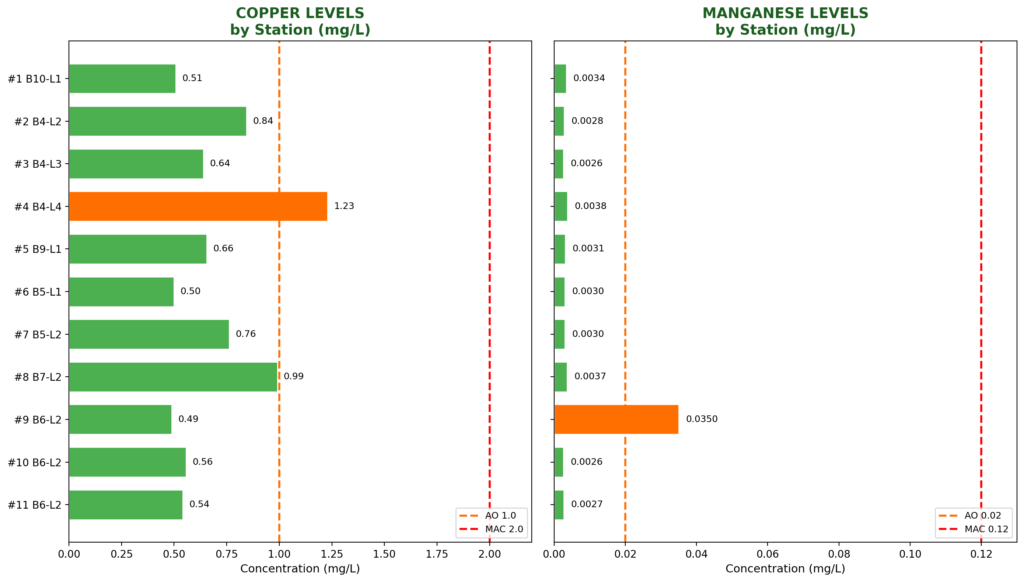
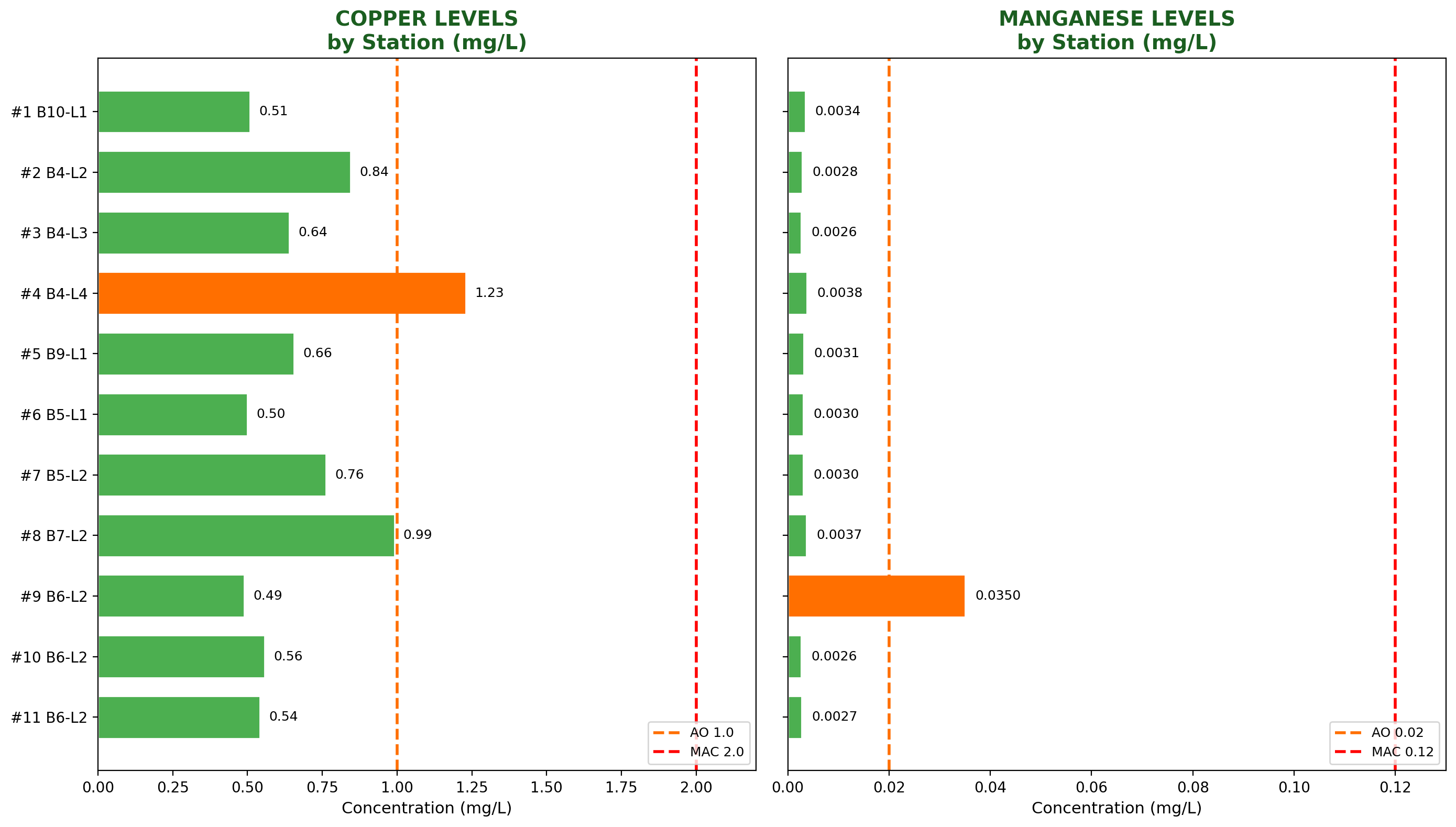
Copper levels varied significantly across campus, and one station stood out. The refill station on Level 4 of Building 4 recorded copper at 1.23 mg/L. That’s above Health Canada’s “aesthetic objective” of 1.0 mg/L (the level at which you might notice a metallic taste), but still well below the health-based limit of 2.0 mg/L.
What does this mean practically? You might notice a slight metallic taste at that station, but it’s not a health concern.
Interestingly, Building 4 as a whole had the highest average copper levels of any building we tested. And within Building 4, copper levels increased with floor level: Level 2 had 0.844 mg/L, Level 3 had 0.640 mg/L, and Level 4 topped out at 1.23 mg/L.
Why the variation? Copper in drinking water typically comes from the plumbing itself. Older pipes, or water that sits in pipes for longer periods, tends to accumulate more copper. The pattern in Building 4 could suggest differences in pipe age, materials, or usage patterns between floors.
### The Manganese Mystery
One station emerged as a clear outlier for manganese: the “cafeside” refill station in Building 6, Level 2. At 0.035 mg/L, its manganese level was about 10 times higher than the other stations, and 1.75 times the aesthetic objective of 0.02 mg/L.
Again, this is well below the health limit (0.12 mg/L), but it’s a notable difference. High manganese can cause staining on fixtures and a slightly off taste. The two other Building 6 stations on the same floor showed normal levels, suggesting this is specific to that one unit, possibly due to localized pipe conditions or sediment buildup.
*It might be worth UNBC Facilities taking a closer look at that particular station.*
## The Environmental Win
Beyond water quality, our sampling revealed something worth celebrating: these stations are making a real environmental difference.
Five of the 11 stations we tested had bottle counters. Between them, they’ve saved over 38,800 plastic water bottles from ending up in landfills. The champion? The Level 1 station in Building 5, with an impressive 30,370 bottles saved.
That’s roughly 490 kg of plastic diverted, and a reminder that every refill counts.
## The Lab Next Door: A Northern BC Success Story
Here’s something you might not know: the lab that analyzed our water samples isn’t in Vancouver or some distant research facility. It’s right here on campus.
The Northern Analytical Laboratory Services (NALS) at UNBC is more than just a university lab. Founded in 2016, it serves as Northern BC’s comprehensive hub for scientific analysis, certified for water microbiology testing with the BC Provincial Health Officer and accredited to ISO 17025:2017 with the Standards Council of Canada.
That matters for the North. Before NALS, communities across our region had to ship samples to labs in the south, adding cost, time, and logistical headaches. Now, whether it’s a First Nation checking their drinking water, a mining company monitoring environmental impacts, or curious students testing their campus water fountains, the expertise is local.
In 2022, the federal agency PacifiCan recognized this value with a $1.92 million investment to establish the Northern BC Environmental & Climate Solutions Innovation Hub within NALS. The initiative focuses on developing new technologies and materials for water management, mining, forestry, and bioenergy, issues that directly affect our region.
Perhaps most importantly, NALS helps keep scientific talent in the North. Trained researchers and technicians can build careers here instead of heading south. That builds long-term capacity and resilience for the entire region.
## The Verdict
**So, should you keep using UNBC’s water bottle refill stations? Absolutely.**
The water is safe at all tested locations. While a couple of stations showed slightly elevated levels of copper or manganese, none approached health-based limits. The variations we found likely reflect normal differences in building plumbing: older pipes, different materials, varying usage patterns.
If you’re particularly sensitive to taste, you might want to avoid the Level 4 station in Building 4 or the cafeside station in Building 6. But from a health perspective? Fill up with confidence.
And next time you’re refilling your water bottle, take a moment to appreciate that the science confirming its safety happened right here, in a lab that’s helping build Northern BC’s scientific capacity, one sample at a time.
## Methodology
Water samples were collected November 25, 2025, from 11 water bottle refill stations across six UNBC campus buildings. Before collecting each sample, we let the fountain run for 30 seconds to flush out any water that had been sitting in the pipes, ensuring the samples were more representative of what students actually drink. Samples were collected in 50mL conical tubes and transported to the Northern Analytical Laboratory Services (NALS) at UNBC.
Analysis was performed November 28, 2025, using modified EPA Method 200.7 (modified EPA 200.8 for arsenic) for 25 metal parameters. Results were compared against Canadian Drinking Water Quality Guidelines.
*Lab Report Reference: 2025NALS02538*
**Learn more about NALS:** nals.unbc.ca | nals@unbc.ca | 250-960-5713